Current research projects
In-depth genomic characterization of organic pollutant-degrading microorganisms
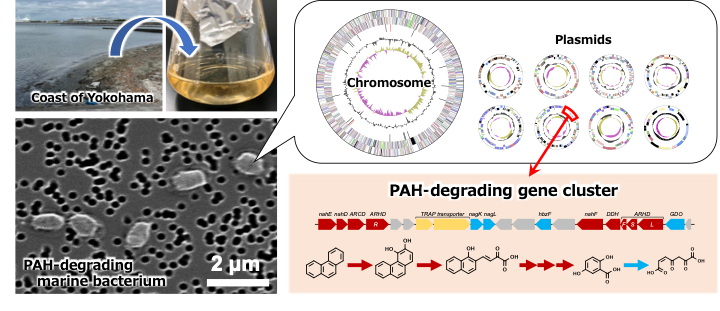
Anthropogenic environmental pollutants, including petroleum-derived compounds, plastics, and pharmaceuticals, are increasingly impacting natural ecosystems. Certain environmental microorganisms can degrade these pollutants and utilize them as carbon and energy sources, thereby playing fundamental roles in ecosystems that emerge in response to environmental pollution. These microorganisms possesses genes responsible for pollutant degradation, and these genes are exchanged among microorganisms through horizontal gene transfer.
Our research focuses on marine bacteria inhabiting chronically polluted urban coastal environments. Through genome sequencing and comparative genomic analyses of pollutant-degrading marine bacteria, we investigate the diversity, distribution, and evolution of degradation-related genes, and also identifying novel genes and enzymes with potential biotechnological applications.
石油に含まれる多環芳香族炭化水素(Polycyclic Aromatic Hydrocarbons, PAH)をはじめとする有害物質や、石油由来のプラスチック、下水を介して環境中に流入する医薬品など、自然生態系に深刻な影響を及ぼしうる人為起源の環境汚染物質は枚挙にいとまがありません。環境中には、これらの汚染物質を分解するとともに、増殖のための炭素源・エネルギー源として利用できる微生物が存在し、それらは環境汚染に応答して形成される生態系の基礎となるはたらきを担っています。これらの微生物は、各種汚染物質の分解に関与する特殊な酵素群をコードする遺伝子群を獲得・進化させながらゲノム上に保持しており、さらに、それらの遺伝子は水平伝播を介して異なる微生物間を頻繁に移動しています。
我々は、多様な汚染物質が継続的に流入する「常在的複合汚染環境」である都市沿岸域に生息する海洋細菌を中心に、個々の汚染物質を分解する能力をもつ細菌を見つけ出し、その完全ゲノム解析、およびデータベース上の既知細菌株ゲノムとの網羅的な比較ゲノム解析を通して、環境中で共有される汚染物質分解遺伝子の分布や多様性を明らかにするとともに、新規の有用遺伝子・酵素の探索を行っています。
Related research articles:
Harada et al., coming soon…
Abe et al., Microbiology Spectrum (2024)
Kayama et al., Microbiology Spectrum (2022)
Mori and Kanaly, Microbiology Spectrum (2022)
Complete genome announcements:
Abe et al., Marine Genomics (2023)
Kayama et al., Microbiology Resources Announcement (2022)
Mori et al., Microbiology Resources Announcement (2021)
Mori and Kanaly, Microbiology Resources Announcement (2021)
Presentations:
Mori et al., ASME, Kochi (2026), Hamamatsu (2023); JSME, Hiroshima (2024)
Adachi et al., ASME, Kochi (2026); JSEB, Tokyo (2026)
Harada et al., JSME, Tokyo (2025); JSEB, Sapporo (2025)
Abe et al., JSME, Hamamatsu (2023)
Comprehensive understanding of pollutant biodegradation mechanisms through coordinated multispecies bacterial behavior
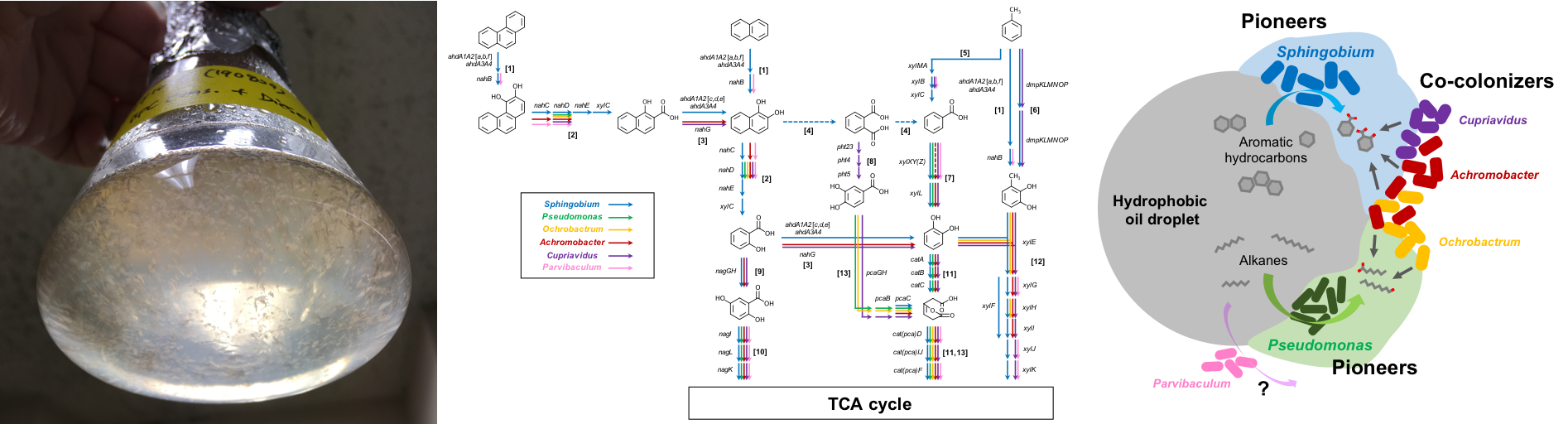
Microorganisms in nature function as complex communities rather than as individuals. In polluted environments, bacteria capable of degrading contaminants initially proliferate, while other species that utilize their metabolic byproducts subsequently accumulate, leading to the formation of new microbial ecosystems. This process is particularly important in petroleum-contaminated environments, where multiple bacterial species interact to form complex degradation networks. Indeed, some structurally complex pollutants can only be completely degraded through the cooperative activities of multiple species.
To understand how such bacterial communities respond to pollution and function collectively as a microbial “superorganism,” we employ two complementary approaches: (i) metagenomic analyses to reconstruct the genomes of key community members and (ii) investigation of interaction mechanisms among isolated bacterial species. Through these studies, we aim to elucidate the principles governing microbial ecosystem development in polluted environments.
環境中で微生物は常に「群集」としてふるまいます。1ミリリットルの海水には約100万個体もの細菌が含まれているとされ、自然界では環境変化に応答して細菌群集の組成がダイナミックに変動します。汚染物質に曝露された環境では、その物質を分解できる一部の細菌がいち早く増殖を始め、やがてそれらの代謝産物を利用する他の種類の細菌が集積することで、新たな微生物生態系が形成されます。特に、多様な物質の混合物である石油に曝露された環境では、複数種の細菌が相互作用しながら複雑なネットワークを形成すると考えられます。実際に、複数種の細菌が共存してはじめて完全分解が可能となる複雑な構造の汚染物質も存在します。
このような、環境汚染に応答して、あたかも一つの「超個体」のように機能する細菌群集の挙動について理解するため、我々は ①群集のメタゲノム解析による主要な細菌種のゲノム情報の解読、②単離した異種細菌間の相互作用機構の探索 の二つのアプローチで研究を進めています。これらの調査を通して、汚染環境における微生物生態系の形成原理や、その普遍的な構築様式の解明につながることが期待されます。
Related research article:
Sato et al., Microbiology (2026)
Mori and Kanaly, Applied and Environmental Microbiology (2020)
Presentations:
Sato et al., ASME, Kochi (2026); JSBBA, Kyoto (2026); JSEB, Tokyo (2026), Sapporo (2025); JSME, Tokyo (2025);
Shimazaki et al., ASME, Kochi (2026); JSEB, Tokyo (2026)
Mori et al., JSME, Sapporo (2022), Yamanashi (2019)
Kayama et al., JSME, Niigata (2021)
Microbial adaptation mechanisms against external stresses
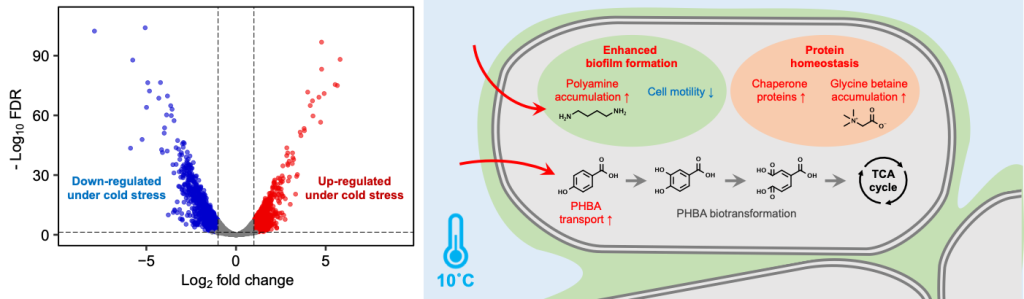
Bioremediation using pollutant-degrading microorganisms is attracting increasing attention as a low-cost and environmentally friendly technology. However, microorganisms deployed in contaminated environments must cope with various stresses, including fluctuations in temperature and pH as well as exposure to toxic agents such as heavy metals, which can limit their growth and activity. Therefore, microorganisms with both strong pollutant-degrading capabilities and high tolerance to environmental stresses are particularly valuable for practical applications.
To identify such microorganisms, we isolate environmentally robust pollutant degraders and investigate their stress adaptation mechanisms through genomic and transcriptomic analyses. Our goal is to elucidate the survival strategies that enable microbial activity under harsh conditions and to provide a foundation for future biotechnological applications.
汚染物質分解能を有する微生物を利用した環境浄化は、低コストかつ環境負荷の小さい技術として関心を集めています。一方で、自然環境は実験室とは大きく異なり、実際の汚染環境で微生物を利用するにあたっては、現場の温度やpHの変動に加え、重金属などの有毒物質によるストレスが微生物の増殖や活性を制限することを考慮に入れる必要があります。したがって、環境浄化への応用には、汚染物質分解能に加えて、多様な外界ストレスを克服できる優れた適応能力をもつ微生物が有用となります。
そこで我々は、汚染物質分解能に加えて優れた環境ストレス耐性を備える微生物を環境中から見つけ出し、それらがもつストレス適応機構をゲノム解析およびトランスクリプトーム解析を通して調査しています。これにより、過酷な環境下でも安定して機能する微生物の生存戦略を明らかにし、バイオテクノロジーへの応用基盤の構築も目指しています。
Related research article:
Yanagita et al., Microbial Genomics (2025)
Tsushima et al., Microbes and Environments (2024)
Genome announcement:
Tsushima et al., Microbiology Resource Announcements (2023)
Presentation:
Yanagita et al., JSME, Hiroshima (2024)
Tsushima et al., JSME, Sapporo (2022)
Past research projects
Microbial ecology in the Canadian oil sands first large-scale end pit lake in Athabasca, Alberta
(2017-2019, supervised by Prof. Lesley Warren, University of Toronto/McMaster University)
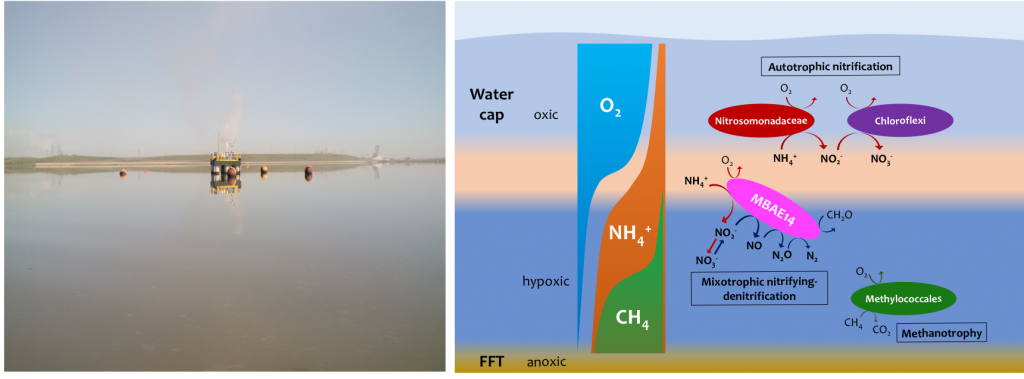
Our combined metagenomic and geochemical survey revealed the presence of putative novel mixotrophic nitrifying-denitrifying bacteria, which dominantly inhabit the ammonia/oxygen transition zone of the world-first oil sands mining pit lake in the Athabasca oil sands region (Alberta, Canada).
Collaborators: Jill Banfield, Lin-Xing Chen (UC Berkeley), Matt Lindsay, Joyce McBeth (Univ. Saskatchewan)
世界で唯一のオイルサンド採掘ピット湖(カナダ・アルバータ州)に生息する微生物群集に対してメタゲノム解析を行い、硝化・脱窒の”二刀流”をこなす新規の細菌の存在を提唱しました。
Related research article:
Jessen et al., Microorganisms (2022)
Mori et al., Frontiers in Microbiology (2019)
Chen et al., mSystems (2019)
Presentation:
Mori et al., ISME17, Leipzig (2018)
Discovery and characterization of Ghiorsea, a novel genus of Zetaproteobacteria
(2015-2017, supervised by Dr. David Emerson, Bigelow Laboratory for Ocean Sciences)
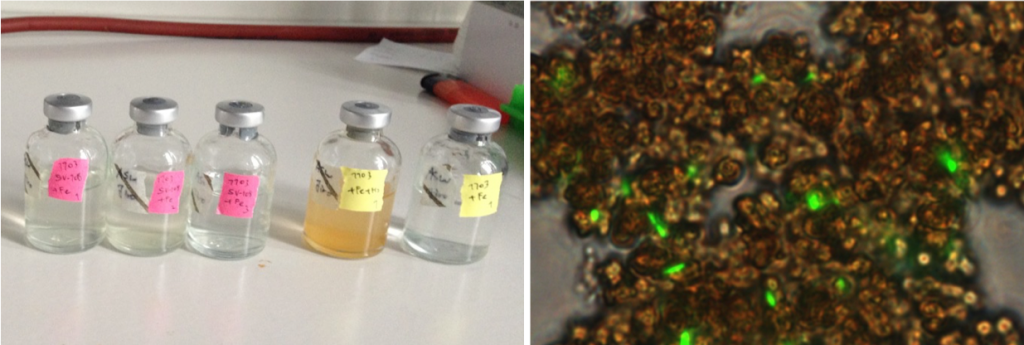
We isolated new genus of Zetaproteobacteria from deep ocean (Mid-Atlantic Ridge and Mariana back-arc), that can utilize molecular hydrogen as sole electron donor (in addition to ferrous iron). It is the first report of the hydrogen-oxidizing capability within the class Zetaproteobacteria.
Collaborators: Craig Moyer, Kevin Hager (Western Washington Univ.)
鉄(II)酸化能に加えて水素酸化能を有するゼータプロテオバクテリアの新属を深海から発見・単離し、詳しい培養試験とゲノム解析を行いました。
Related research article:
Mori et al., The ISME Journal (2017)
Fe-rich pelagic lake aggregates (“iron snow”) generated by the Fe-cycling bacterial team
(2013-2017, supervised by Prof. Kirsten Küsel, Friedrich-Schiller-University Jena)
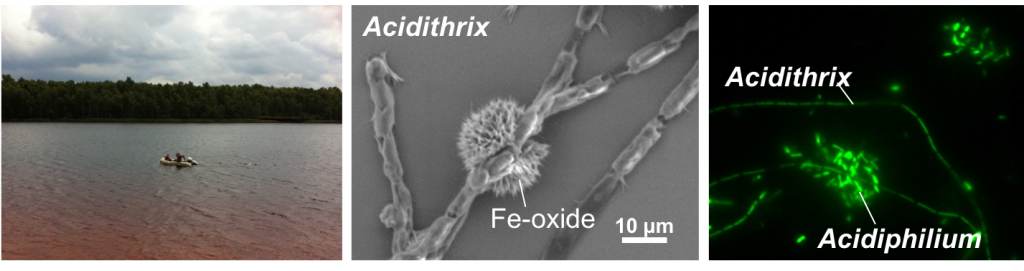
Pelagic lake aggregates enriched with Fe-oxides (called iron snow) are formed by the simple bacterial community inhabiting in an acidic, Fe-polluted former lignite mining pit lake in Eastern Germany. These lake aggregates can be considered as a simplified model of bacterial interactions in the pelagic communities. We isolated a novel unique Fe-oxidizing bacterium Acidithrix, which plays a central role to form iron-rich aggregates. Additionally, potential chemical cross-talking, co-aggregation system evolved between Acidithrix and Fe-reducing Acidiphilium was revealed by our metabolomics study, which is a rare example of bacterial inter-species chemical communication.
Collaborators: Georg Pohnert, Nico Ueberschaar, Kai Uwe Totsche, Matthias Händel, Jürgen Popp, Nicolae Tarcea (FSU Jena), Thomas Neu (Helmholtz Centre UFZ)
ドイツ東部の旧褐炭鉱山ピット湖において鉄リッチな凝集体を形成するユニークな鉄酸化細菌Acidithrixを単離しました。また、Acidithrixと共存する鉄還元細菌Acidiphiliumが化学物質を介して情報伝達をしており、共凝集している現象をメタボロミクス解析により明らかにしました。これは、異種細菌間での化学コミュニケーション機構を報告した希少な例となりました。
Related research article:
Mori et al., The ISME Journal (2017)
Mori et al., Microbiology (2016)
Presentation:
Mori et al., ISME16, Montreal (2016)
Mori et al., Goldschmidt2016, Yokohama (2016)
Mori et al., Gordon Research Conference, Applied and Environmental Microbiology, Mount Holyoke (2015)
Streamer-forming algae-mineral-bacteria assemblages in heavy metal-polluted groundwater outflow
(2013-2015, supervised by Prof. Kirsten Küsel, Friedrich-Schiller-University Jena)
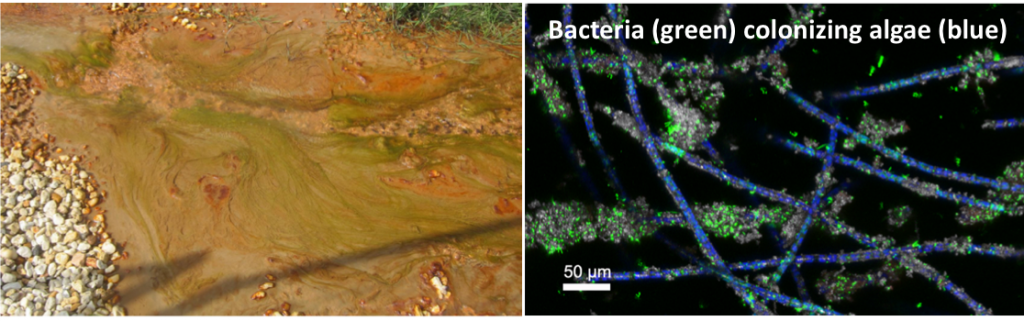
Conspicuous, streamer-forming microbial assemblages were observed in a former uranium-mining district in Eastern Germany. Our microbial community analyses and microscopic visualization revealed that the dominant Fe-oxidizing bacterium Gallionella were colonizing macroscopic green algae Tribonema, presumably utilizing algal exopolymer (i.e. EPS) to stick and dump the Fe-oxides.
Collaborator: Thomas Neu (Helmholtz Centre UFZ), Kai Uwe Totsche, Matthias Händel (FSU Jena)
ドイツ東部の旧ウラン鉱山では高濃度の重金属を含む地下水が滲出しており、そこで活発に生育しているGallionella属の鉄酸化細菌は多細胞藻類Tribonemaにべったりとまとわりついていました。顕微鏡で観察したところ、藻類が作る細胞外多糖(いわゆるEPS)を細菌が利用し、産生した酸化鉄を蓄積させていることも示唆されました。
Related research article:
Mori et al., Biogeosciences (2015)
Presentation:
Mori et al., ISME15, Seoul (2015)