


Research
Elucidation of Host Response Regulatory Mechanisms Mediated by DAMPs
― Decoding “Dying Messages” Released from Damaged Cells ―
When the body encounters critical conditions such as cancer, tissue injury, or infection, it is equipped with sophisticated regulatory mechanisms that sense these threats and elicit appropriate responses to restore homeostasis. In these processes, inflammatory responses play a crucial role. However, excessive or chronic inflammation is known to result in tissue damage and disease progression. Despite this, the mechanisms by which inflammation is induced following damage to self-cells or tissues, and why such inflammation fails to resolve and instead becomes chronic, remain incompletely understood.
Our research focuses on endogenous molecules released from damaged or dying cells, collectively referred to as danger-associated molecular patterns (DAMPs), also known as damage-associated molecular patterns or alarmins. We aim to elucidate the roles of these molecules in regulating host responses and inflammatory processes.
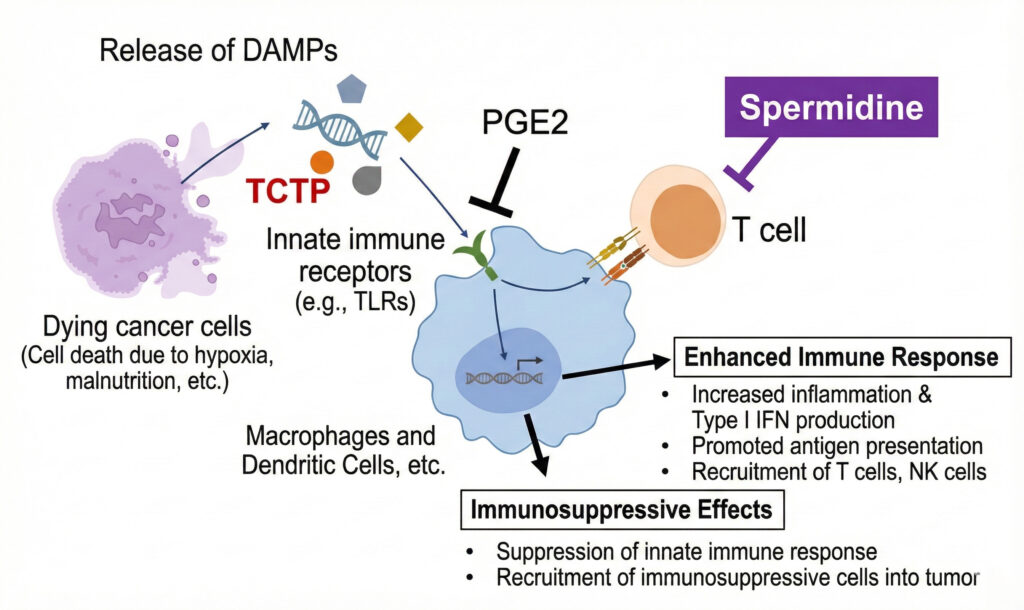
We have previously demonstrated that prostaglandin E₂ suppresses DAMP-induced inflammatory responses (PNAS, 113: 3844–3849, 2016), and identified translationally controlled tumor protein (TCTP) as a novel endogenous ligand recognized by Toll-like receptor 2 (TLR2) (Nat Immunol, 22: 947–957, 2021) (Fig. 1). Furthermore, we discovered that spermidine, a polyamine released from dying cancer cells, inhibits T cell activation and suppresses anti-tumor immune responses (PNAS, 120: e2305245120, 2023) (Fig. 1).
In addition, we are currently engaged in identifying novel molecular groups involved in the maintenance of homeostasis. By employing molecular biological techniques and advanced omics-based analyses, we seek to uncover regulatory mechanisms of crisis responses through the identification and functional characterization of DAMPs.
Elucidation of the Roles of DAMPs in the Tumor Microenvironment and the Regulation of Tumor Immunity and Pathophysiology
During tumor growth and in response to therapeutic interventions, large numbers of damaged and dying cells are generated within tumor tissues. These cells release a variety of endogenous molecules and metabolites, including damage-associated molecular patterns (DAMPs), which are thought to play critical roles in disease progression by modulating immune cell activation or suppression and altering intercellular interactions within the tumor microenvironment.
Our studies have revealed that molecules derived from dying cells include not only those that promote immune responses, but also factors that suppress excessive immune activation and regulate the quality and persistence of immune responses.
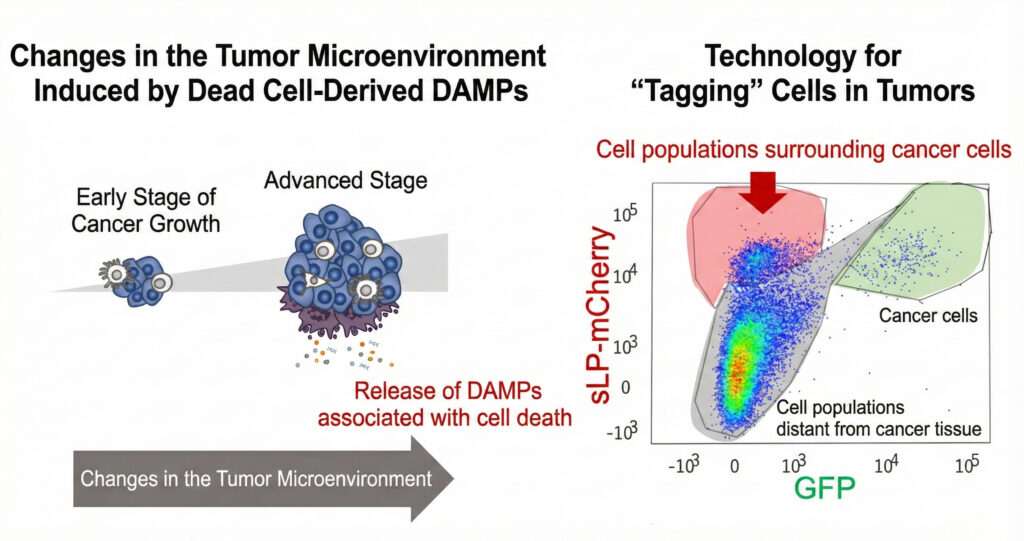
Currently, beyond the conventional framework of the tumor immune microenvironment, we are investigating the roles of dying cell–derived molecules from the perspectives of local stress responses, disruption of tissue homeostasis, and organ- and tissue-specific host response regulatory mechanisms. In addition to mouse model–based analyses, we have introduced a microenvironment labeling approach that enables spatiotemporal tagging and tracking of the tumor microenvironment (Fig. 2), allowing us to analyze dynamic changes in the microenvironment during tumor progression and therapeutic intervention.
Furthermore, by integrating these approaches with omics-based analyses, we aim to achieve a comprehensive understanding of immune regulatory networks that differ among tumor tissues. Through these studies, we seek to elucidate fundamental principles governing tumor immunity and to facilitate the identification of novel therapeutic target molecules and the development of innovative immunotherapeutic strategies.