

At the Structural Epigenetics Laboratory (Konuma Group), we investigate the mechanisms of gene expression regulation involved in cancer and inflammation using structural biology approaches. We aim to understand the structure and function of histone-modifying enzymes and reader proteins related to transcription at the atomic level, with the ultimate goal of developing novel therapeutics through epigenomic drug discovery.
Research
Research method
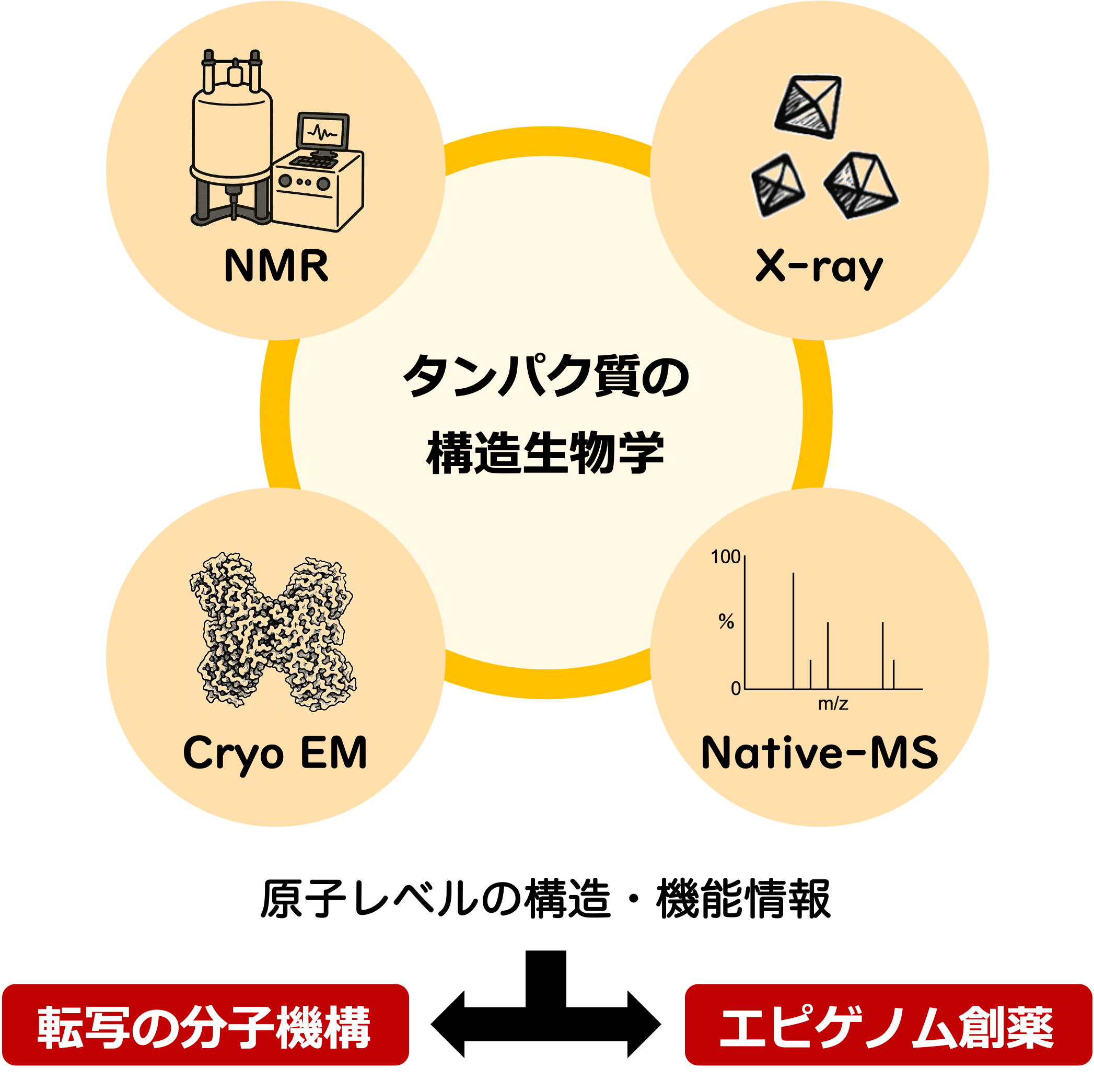
Our research integrates various structural biology techniques, including NMR spectroscopy, X-ray crystallography, cryo-electron microscopy, and native mass spectrometry.
Guidance Policy
We welcome highly motivated individuals who are passionate about research. Daily discussions about research topics are a given, and members are expected to strategically secure research funding and scholarships. Whenever possible, you will take on multiple projects and work collaboratively with domestic and international research partners to tackle scientific challenges. As we are still a small group, one of our strengths is the close and accessible relationship with faculty members.
Research Topics
Functional Analysis of Non-Canonical Histone Post-Translational Modifications and Elucidation of Transcriptional Regulation Mechanisms
To understand the mechanisms of transcription, it is essential to identify enzymes and reader proteins responsible for histone post-translational modifications (PTMs). For instance, reader domains such as bromodomains and chromodomains have been identified for classical histone modifications like acetylated and methylated lysines, and their roles in transcription are well understood. However, for recently discovered non-canonical histone modifications, our understanding of the associated proteins remains limited, and thus their biological functions are still unclear.
Our group previously identified a reader protein for crotonylation, one such non-canonical modification, and have been working to elucidate the transcriptional regulation mechanisms of various genes. Through these studies, we have uncovered how such mechanisms contribute to cancer cell proliferation (Liu et al., Mol Cell 2023; Konuma et al., J Mol Biol 2024). Furthermore, we are conducting detailed molecular investigations to determine how commonly crotonylation-mediated transcriptional regulation occurs in comparison to acetylation and methylation. By expanding our observational resolution from the molecular to cellular level, we are also studying phase-separated “droplets” that serve as hubs of aberrant transcriptional control in cancer cells.
Drug Discovery Targeting BET Family Proteins
In the field of epigenomic drug discovery targeting transcription-related proteins, several histone deacetylase (HDAC) inhibitors have been approved for cancer therapy. However, no drugs targeting histone acetyltransferases (HATs) or reader proteins have yet reached the market. Among these readers, the BET family (BRD2, BRD3, BRD4, BRDT) is well known for recognizing acetylated lysines, and many inhibitors targeting their bromodomains are in development for cancer and inflammatory diseases. Nonetheless, significant side effects remain a major hurdle.
To address this, our research has shifted focus from the bromodomain to the ET domain of these proteins. The ET domain is responsible for recruiting transcription-related proteins to histones and interacts with various partners. We have used NMR spectroscopy to determine the structural basis of multiple ET domain complexes and elucidated their interaction mechanisms (Zhang et al., Structure 2016; Konuma et al., Sci Rep 2017). Based on atomic-level structural data, we are currently developing small and medium molecule inhibitors that target the ET domain. We have already observed synergistic anticancer effects when combining our ET domain inhibitors with existing bromodomain inhibitors, and we aim to propose new therapeutic strategies. Additionally, by conducting biophysical and transcriptomic analyses using these inhibitors, we are further investigating the respective roles of the ET and bromodomains in transcriptional regulation and gaining deeper insights into the biological functions of the BET family (Azegami et al., Mass Spectrom 2022).
Methodology Development for Single-Cell Native Mass Spectrometry
With the goal of enabling drug screening from ultra-small samples, we are developing methodologies for native mass spectrometry (native MS). As widely known, mass spectrometry is among the most sensitive analytical techniques. However, conventional MS typically requires denaturing conditions, such as organic solvents, which disrupt protein structure. In contrast, native MS analyzes proteins under non-denaturing conditions, allowing the detection of intact protein complexes.
Historically, this technique has only been applicable to purified proteins. Consequently, proteins that aggregate or express at low levels could not be analyzed by native MS due to purification limitations. To overcome this, we developed a technique that directly applies crushed E. coli expressing the target protein to native MS without purification (Takano et al., Anal Bioanal Chem 2020). We then extended this method to human cells, beginning by successfully detecting hemoglobin directly from large numbers of red blood cells. After optimizing measurement conditions, we achieved the world’s first detection of hemoglobin tetramers from a single red blood cell via native MS (Sakamoto et al., Anal Chem 2021).
As a next step, we have successfully detected overexpressed target proteins from HEK293 cells. Additionally, while purification is still required, we have succeeded in applying native MS to membrane proteins in the presence of surfactants (Tajiri et al., ACS Omega 2023). Currently, we are developing techniques that allow spatial and temporal analysis of target samples within cells by directly inserting a capillary into cells for native MS analysis.
Member
Associate Professor

Tsuyoshi KONUMA
Technical Assistants
Nanako TOYODA
Yuko FURUDOI
Students
Sayaka HOKAZONO
M2 >>
Rino EBINUMA
B4 >>
Michinari YABE
B3
Publications
Please refer to Researchmap.
https://researchmap.jp/7000023013/published_papers
Contact
Laboratory of Structural Epigenomics,
Graduate School of Medical Life Science,
Yokohama City University
1-7-29 Suehiro-cho, Tsurumi-ku, Yokohama
〒230-0045 JAPAN
メール:konumax[at]yokohama-cu.ac.jp
※Please replace “[at]” with “@”.